
HubSpot Webhooks: Refresh Google Sheets the Moment a Deal Changes

Your HubSpot pipeline moves all day, but a spreadsheet only knows what happened at its last refresh. With webhooks in G-Integrator for HubSpot, a change in HubSpot can tell Google Sheets to update itself right away. Each spreadsheet gets a secret, token-protected webhook URL. Call it, and G-Integrator re-runs your saved query templates and writes fresh HubSpot data into the sheet within seconds.

What HubSpot webhooks add

Before webhooks, a sheet refreshed when you clicked the add-on menu or when a scheduled workflow ran. Now there is an event-driven option: the moment a contact, company or deal changes, HubSpot (or any tool watching it) can trigger the refresh.

  • Instant updates. Your sheet changes when HubSpot data changes, not on the next hourly run.
  • Runs on our servers. The refresh works even while the spreadsheet is closed.
  • Your layout stays intact. Saved templates are re-run exactly as you built them.
  • Any trigger works. HubSpot workflows, Zapier, Make, a cron job or a simple browser bookmark.

A webhook refreshes anything the HubSpot add-on can pull, including contacts, companies, deals, and the 35+ built-in analytics reports.

Set up a HubSpot webhook for Google Sheets

  1. In the add-on menu, open Automation… → Manage Webhooks.
  2. Click Generate / Rotate Token to create your webhook URL.
  3. Click Authorize Google once per spreadsheet so G-Integrator can write the refreshed data.
  4. Choose a Run target: all templates or a single workflow.
  5. Click Copy URL and paste it wherever the refresh should be triggered.
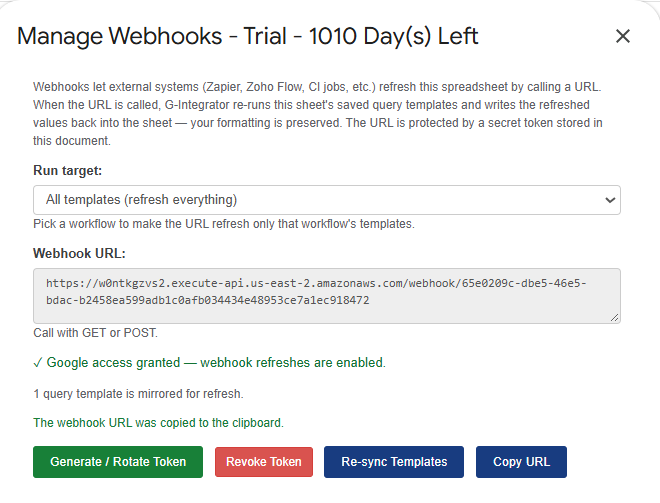
The URL accepts both GET and POST requests. To refresh only one workflow’s templates, add ?workflow=<workflow-uuid> to the URL; the dialog builds it for you.

Trigger the refresh from a HubSpot workflow

In HubSpot, create a workflow with the enrollment trigger you care about, such as a deal moving to Closed Won. Add a Send a webhook action, choose GET or POST, and paste your G-Integrator URL. Webhook actions in HubSpot workflows depend on your HubSpot subscription. If yours does not include them, Zapier or Make can watch HubSpot and call the URL instead.

Ideas for HubSpot teams

  • Closed won, sheet updated. A deal stage change calls the webhook, and your sales dashboard shows the win in seconds.
  • Fresh lead lists. New form submissions trigger a refresh of the contacts sheet your sales reps work from.
  • Ready for the pipeline review. Save the URL as a bookmark and click it before the weekly sales meeting.
  • Always-current dashboards. Call the webhook before Looker Studio reads the sheet, so reports never show stale numbers.

Logged, secured and rate-limited

Every webhook run appears in the Automatic Operations Events Log tab, next to your scheduled workflows, so you can confirm a trigger fired and see which sheets changed. If a URL leaks, rotate the token in Manage Webhooks and the old URL stops working at once, or revoke the token entirely. By default each webhook runs at most once per hour. Extra calls are rejected without touching your data, and the JSON response tells you when to retry.

Try HubSpot webhooks today

Webhooks come with the Premium subscription at no extra cost, and LITE users get a two-week trial. Open Automation… → Manage Webhooks in G-Integrator for HubSpot to connect your first trigger. Using Zoho too? See our Zoho webhooks guide.

Webhooks: Refresh Your Zoho Data in Google Sheets the Moment Something Changes

Scheduled refreshes are great — until a deal closes two minutes after the last run. Our newest feature removes the wait: both G-Integrator for Zoho CRM and G-Integrator for Zoho Books now support webhooks. A webhook is a secret, token-protected URL for your spreadsheet. Any system that can make an HTTP request can call it, and G-Integrator re-runs your saved query templates and writes fresh Zoho data back into your sheet — within seconds.

Why webhooks?

Until now, you had two ways to update a sheet: click the add-on menu or wait for a scheduled workflow. Webhooks add a third, event-driven option. The moment something happens in your CRM or your books, the system that saw it first can tell your spreadsheet to refresh itself.

  • No schedule needed. Data updates when the event happens, not at the top of the hour.
  • Nothing to deploy. Refreshes run on the G-Integrator servers — they work even while the spreadsheet is closed.
  • Formatting preserved. Your saved templates are re-run exactly as you built them.
  • Works with everything. Zoho Workflow Rules, Zoho Flow, Zapier, Make, a cron job, a CI pipeline — even a browser bookmark.

Webhooks refresh everything the add-ons can pull. For Zoho CRM that means module records, related lists, COQL queries, Zoho Analytics reports and the built-in CRM reports. For Zoho Books, all your saved query templates.

Setup takes a minute

  1. Open Automation… → Manage Webhooks in the add-on menu.
  2. Click Generate / Rotate Token — the dialog shows your webhook URL.
  3. Click Authorize Google (once per spreadsheet) so our server may write the refreshed values into your sheet.
  4. Pick a Run target: refresh all templates, or just one workflow’s templates.
  5. Click Copy URL and paste it into the system that should trigger the refresh.
Manage Webhooks dialog with token, run target and webhook URL
The Manage Webhooks dialog: generate a token, pick a run target, copy the URL.

The URL supports both GET and POST, so it drops straight into a Zoho CRM Workflow Rule webhook action, a Zoho Flow step, or a one-line curl call. Add ?workflow=<workflow-uuid> to refresh only one workflow’s templates — the dialog builds that URL for you.

Real-life examples

  • Deal won → dashboard updated. A Zoho CRM Workflow Rule on Stage = Closed Won calls the webhook, and your pipeline sheet reflects the win within seconds.
  • Invoice paid → cash flow current. A Zoho Books automation fires on Invoice Status = Paid, and the accounts-receivable sheet updates itself.
  • Meeting prep in one click. Keep the URL as a browser bookmark and click it before the Monday pipeline review or the month-end close.
  • Dashboards that are never stale. Call the URL from your BI tool’s pre-run hook so Looker Studio always reads current data.
  • Targeted refresh. After a campaign import or bank-feed categorization, refresh just that one workflow instead of the whole workbook.

Every run is logged in your sheet

Each webhook run is recorded in the Automatic Operations Events Log tab — the same log used by scheduled workflows. You can verify that an external trigger fired, see exactly which sheets were updated, and diagnose failures without leaving the spreadsheet.

Automatic Operations Events Log sheet filled by a webhook run
Webhook runs in the Automatic Operations Events Log.

Secure by design

The token is the key. If the URL ever leaks, open Manage Webhooks and click Generate / Rotate Token — old URLs stop working immediately. You can also Revoke Token to disable the webhook entirely. Each webhook runs once per hour by default; calls over the limit are rejected without changing any data, and the JSON response tells you when to retry. Need it fresher? Tell us about your use case — we are considering a lower rate limit as a paid option.

Try it today

Webhooks are included in your Premium subscription at no extra charge. For the LITE subscription, you have two trial weeks. Open Automation… → Manage Webhooks in G-Integrator for Zoho CRM or G-Integrator for Zoho Books and connect your first trigger. Full details are in the help center: Zoho CRM webhooks and Zoho Books webhooks.