
New Feature: Easily Disconnect G-Integrator from Your HubSpot Account

Dear clients,

As part of our ongoing commitment to making the G-Integrator app safer and more transparent, we’ve added a small but important new feature – a menu option that allows you to disconnect G-Integrator from your HubSpot account.

To understand why this might be useful, let’s briefly go over how the connection works.

When you first sign in to your HubSpot account through G-Integrator, HubSpot displays the app authorization screen. By clicking “Connect app”, you grant G-Integrator permission to read and write specific data in your HubSpot account – exactly as described on that screen.

We deeply value your trust and will never misuse these permissions. However, we recognize that you may sometimes wish to revoke access.

You can always do this directly in your HubSpot account by navigating to Integrations → Connected Apps, then selecting Uninstall (see our FAQ for detailed steps). But in the spirit of full transparency, we wanted to make it even simpler – just one click away.

That’s why we’ve introduced a new menu option:
About → Disconnect G-Integrator from my HubSpot account

Selecting this option will send a secure API call to HubSpot to disconnect G-Integrator from your account. None of your HubSpot data will be affected, and you can reconnect anytime by choosing HubSpot Sign In menu again.

We hope you’ll never need to use this option – but it’s there for your peace of mind.
Upload to multiple tables

Attention all HubSpot users! We have some exciting news for you. The G-Integrator for HubSpot just got even better. We have added new functionality that will allow you to upload data to multiple tables at once. This means that you can now create new deals and simultaneously add associated contacts and line items with ease.

To use this new functionality, you will need to open the menu “Upload” → “Upload to HubSpot multiple tables”. From there, you can select the master table, which in this case would be “Deals”. Then you will need to add field mapping for it. Once that is done, you can select the detailed table, which could be “Contacts”. Again, add the field mapping for this table. If you have another detail table, you can add that as well.

With this new functionality, you no longer need to upload data to each table separately, which can be time-consuming and prone to errors. Instead, you can upload all the necessary data in one go, saving you time and effort. This is especially useful for those who have complex data structures in HubSpot, where multiple tables are linked together.

The G-Integrator for HubSpot has always been a great tool for managing sales data, but with this new functionality, it has become even more powerful. You can now upload data to multiple tables with ease, without having to worry about errors or missing information.

Let’s have a look at it. In our example, we will upload to HubSpot five deals. Each deal row in the spreadsheet will also have a first name, last name, and email of the associated contact and name, price, and SKU of the line item.

In summary, the G-Integrator for HubSpot now supports uploading data to multiple tables, making it easier and more efficient to manage your sales data in HubSpot. To use this new functionality, simply open the menu “Upload” → “Upload to HubSpot multiple tables”, select the master table, add the field mapping for it, and then select the detailed tables and add field mapping for them as well. If you have any questions about this new functionality or need help setting up your integration, please don’t hesitate to contact our support team.

Service Spreadsheets timed out error

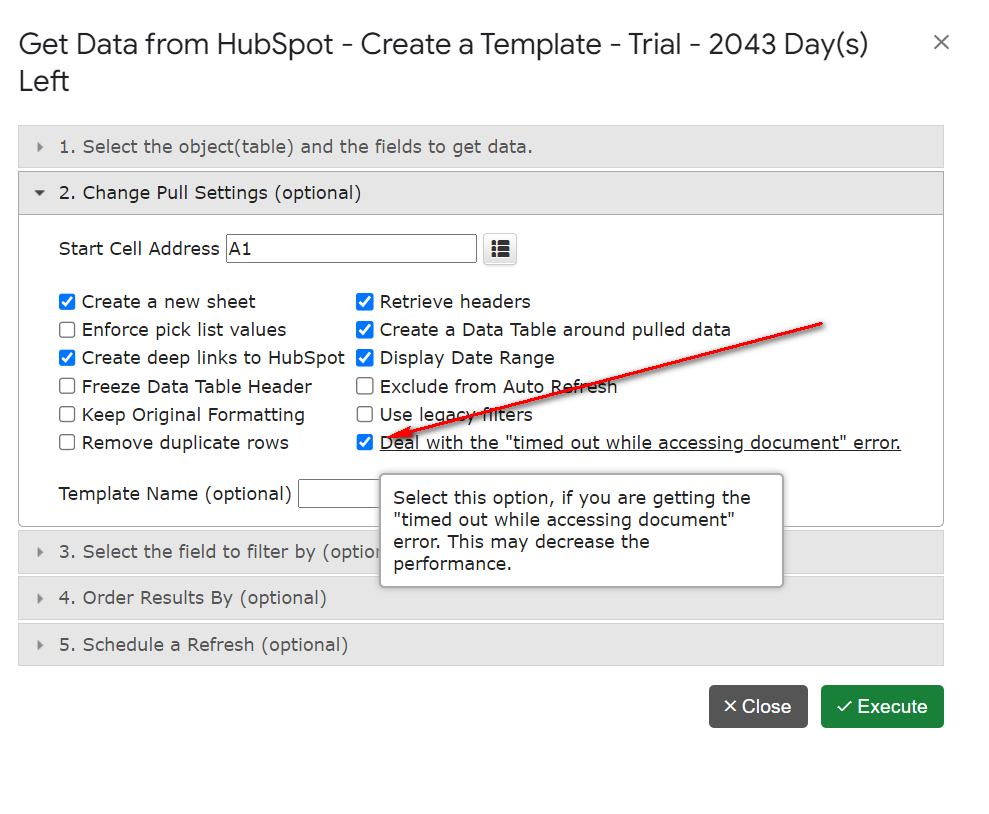
Dear clients, sometimes you will see the “Service Spreadsheets timed out” error while using G-Integrator to update the spreadsheet.

This is a known issue in the Google Script engine. We have a workaround for this. While it can’t give 100% reliability, it still works quite well, despite it will slow down the execution.

S, if you have got this error, please check the “Deal with timed out while accessing document” checkbox in the “Change Pull Settings” tab. We hope, that this will solve the problem.